
Why AI Content Is Making Brands Invisible
MindFount Admin
Author
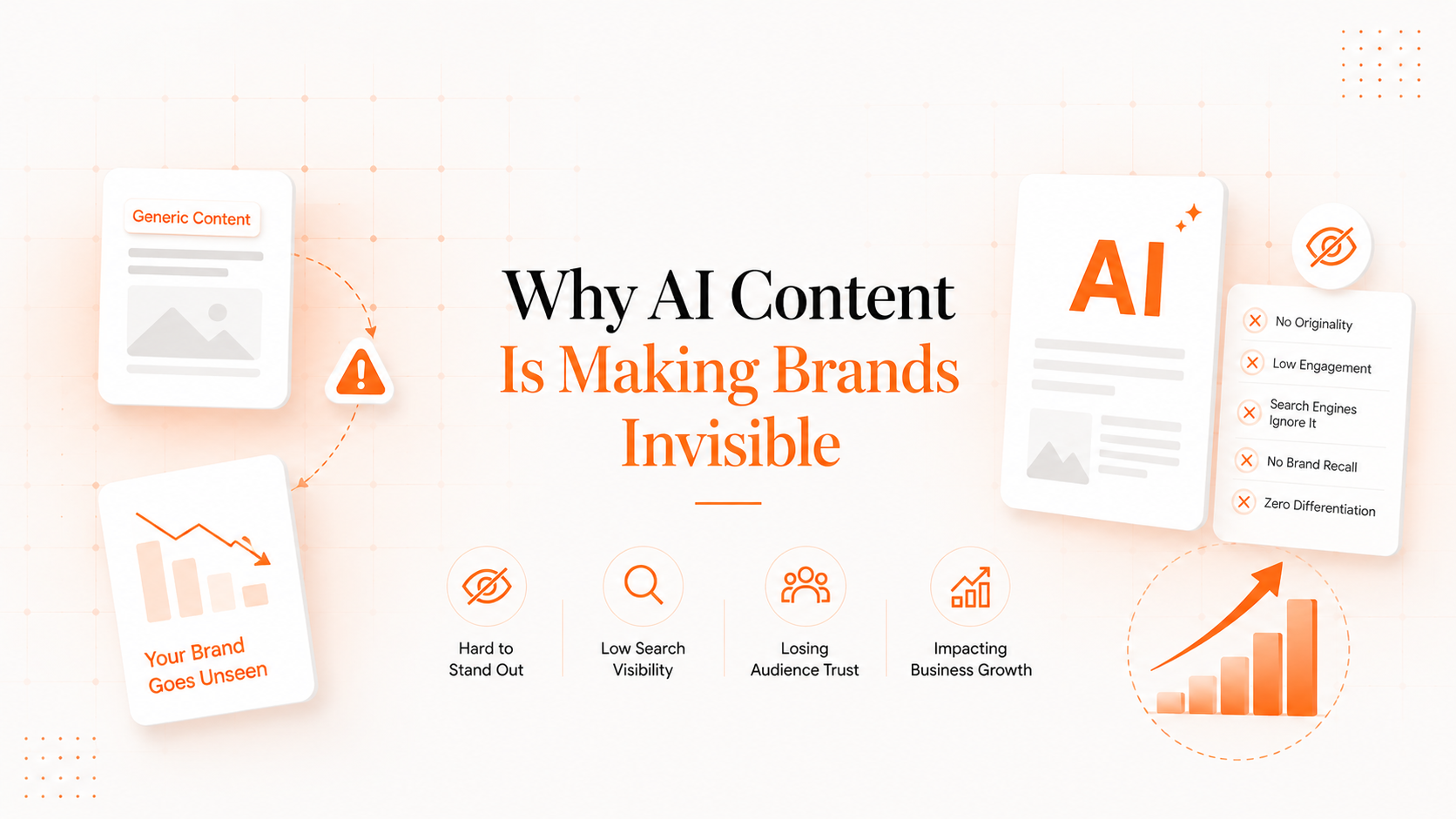
Why AI Content Is Making Brands Invisible
In 2026, millions of brands are pumping out more content than ever before. Blog posts, social media captions, LinkedIn articles, YouTube scripts, email newsletters — all generated in seconds using AI tools. It looks productive. It feels efficient. But something dangerous is happening beneath the surface. Brands are slowly, quietly disappearing. Not from search engines. Not from social media feeds. But from the minds and hearts of their audience. And the weapon responsible? The very AI content they thought would save them.
The AI Content Explosion — Too Much of Everything
Let's start with a hard truth. AI has made content creation so easy that everyone is doing it. Every brand, every startup, every solopreneur is now publishing daily. The internet is flooded. But here's the problem — when everyone uses the same AI tools, trained on the same data, with the same default prompts, the output sounds identical.
Think about the last ten articles you read online. How many of them started with "In today's fast-paced digital world"? How many ended with "In conclusion, it is clear that..."? How many felt like they were written by the same invisible robot?
That is exactly what is happening to brands right now. AI content is creating a sea of sameness. And in a sea of sameness, no brand stands out. No brand builds loyalty. No brand becomes memorable. The audience scrolls past. The algorithm deprioritizes. The brand fades.
According to recent digital marketing studies, average content engagement rates dropped by over 34% between 2024 and 2026 — directly correlated with the mass adoption of AI writing tools. More content, less impact. More words, less meaning.
The Trust Crisis — Audiences Can Feel the Difference
Here is something no AI tool will tell you. Human beings are wired for authenticity. We have spent thousands of years reading facial expressions, detecting fake smiles, and sensing when someone is not being genuine. That same instinct works when we read content online.
When a brand publishes AI-generated content without any human touch, audiences feel it. They may not be able to explain it, but something feels off. The stories lack real experience. The opinions have no edge. The advice sounds generic. There is no personality, no vulnerability, no unique point of view.
And when audiences feel that disconnect, they do not complain. They do not comment. They simply leave. They unfollow. They unsubscribe. They forget the brand ever existed.
This is the invisible brand syndrome. Your content exists, but your brand does not. You are publishing, but no one is listening. You are present, but completely forgettable.
A 2025 Nielsen Trust Report found that 71% of consumers say they are less likely to trust a brand whose content feels automated or impersonal. Trust is the foundation of every purchase decision. Destroy trust and you destroy your business — slowly, quietly, and completely.
The SEO Trap — Ranking Without Relevance
Many brands turned to AI content specifically for SEO. Produce more articles, target more keywords, climb the rankings. And for a while, it worked. But Google's Helpful Content algorithm updates in 2025 and 2026 have fundamentally changed the game.
Google no longer rewards volume. It rewards value. It rewards original research, first-hand experience, unique insights, and content that genuinely helps real people solve real problems. AI content that regurgitates existing information — no matter how well it is formatted — is being actively suppressed in search rankings.
Brands that built their entire content strategy on AI-generated articles are now watching their organic traffic collapse. Pages that ranked on page one are dropping to page three, five, and beyond. The AI content shortcut has become a long-term SEO liability.
The Fix — How to Use AI Without Becoming Invisible
Here is the good news. AI content is not the enemy. Lazy content is. The brands that are winning in 2026 are not abandoning AI — they are using it smarter. They are using AI to research, outline, and draft — but they are injecting real human voice, original stories, genuine opinions, and brand-specific insights into every single piece of content they publish.
The formula that works looks like this. Start with your human expertise and original perspective. Use AI to structure and accelerate the writing process. Then add your brand's authentic voice, real customer stories, data from your own experience, and opinions that only your team can hold. The result is content that is both efficient and genuinely valuable.
Great brands in 2026 are also diversifying beyond text. Short-form video, founder-led content, behind-the-scenes storytelling, community conversations — these formats are impossible to fully automate and they are exactly what builds deep brand loyalty.
Conclusion:
The brands that will dominate the next five years are not the ones publishing the most content. They are the ones publishing the most human content. Content with a real voice, a real point of view, a real purpose.
AI is a powerful tool. But a tool is only as good as the hand that holds it. If you have been hiding behind AI-generated content and wondering why your brand feels invisible, this is your wake-up call.
Stop creating content that sounds like everyone else. Start creating content that sounds unmistakably like you.
Because in a world full of AI voices, the most powerful thing your brand can do — is be human.
Written by MindFount Admin
Contributing author at MindFount.