From Idea to Campaign: How to Automate 80% of Your Marketing Workflow with Agents
MindFount Admin
Author
From Idea to Campaign: How to Automate 80% of Your Marketing Workflow with Agents
Marketing used to be linear. You had an idea, built creatives, launched campaigns, and then waited for results. Today, that model is too slow, too manual, and too dependent on constant human effort. The brands that are scaling faster are not working harder, they are building systems that work for them.
At the center of this shift is marketing automation, powered by intelligent agents that can execute, optimize, and adapt in real time. What once required a team can now be handled through a streamlined marketing workflow where repetitive tasks are automated and strategic decisions are enhanced by data.
The goal is not to remove humans from marketing. It is to remove inefficiency.
The Problem with Traditional Marketing Workflows
Most businesses still operate with fragmented systems. Ideas are discussed in meetings, content is created in isolation, campaigns are launched manually, and performance is reviewed much later than it should be. Every step involves delays, miscommunication, and dependency on multiple tools and people.
This kind of workflow creates friction. Not just in execution, but in decision-making. By the time insights are gathered, the opportunity to act on them has already passed. This is where campaign management starts breaking down — not because of poor strategy, but because of slow execution.
What Changes When Agents Enter the System
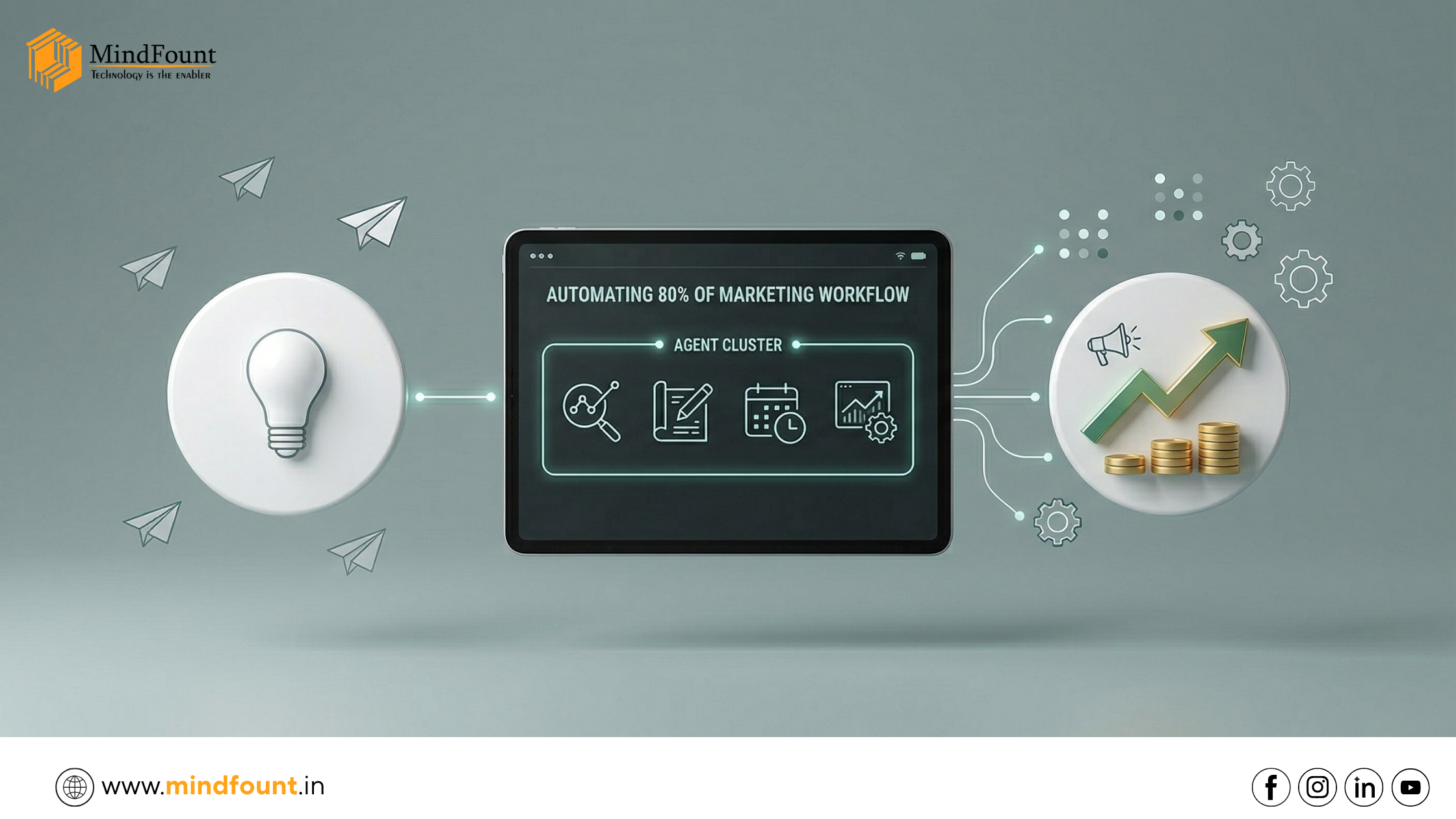
Agents act as independent units within your system. Instead of manually handling each task, you assign responsibilities to these agents, from research and content creation to distribution and optimization.
Think of them as always-on operators inside your marketing workflow. They don’t wait, they don’t forget, and they continuously learn from data. This transforms your process from reactive to proactive.
For example, instead of manually analyzing campaign performance at the end of the week, an agent can monitor results in real time, detect underperformance, and trigger adjustments immediately. This is where marketing automation becomes more than convenience — it becomes a competitive advantage.
Breaking Down the 80% You Can Automate
A large portion of marketing work is repetitive. Ideation, drafting, scheduling, reporting, and optimization follow predictable patterns. These are precisely the areas where agents perform best.
An idea can be turned into structured content within minutes. Instead of brainstorming from scratch, agents can analyze trends, generate angles, and suggest hooks aligned with your audience. Content creation becomes faster, but also more consistent.
Once content is ready, distribution no longer needs manual scheduling across platforms. Automated systems ensure that posts go live at optimal times, adapted for each channel. This eliminates delays and improves reach without additional effort.
In campaign management, agents can handle bid adjustments, budget allocation, and audience refinement. Rather than reacting after performance drops, the system continuously optimizes in the background. This leads to more stable and predictable results.
Even reporting, which traditionally consumes hours, becomes instantaneous. Instead of compiling data manually, you get real-time insights that highlight what is working and what needs adjustment.
What You Should Not Automate
Automation is powerful, but it is not a replacement for thinking. Strategy, positioning, and brand voice still require human judgment. These elements define how your audience perceives you, and they cannot be fully delegated.
The role of automation is to support these decisions, not make them in isolation. When used correctly, it frees up time for deeper thinking and creative exploration. Instead of being stuck in execution, you focus on direction.
From Effort to System
What separates scalable brands from struggling ones is not effort, it is structure. When your marketing workflow is automated, your output becomes consistent, your decisions become faster, and your campaigns become more efficient.
This is how marketing automation with agents transforms growth. It replaces fragmented processes with connected systems. It reduces dependency on manual intervention and increases the speed at which you can test, learn, and scale.
In a competitive environment, that speed is everything.
Final Thought
You don’t need to automate everything. But if 80% of your work is repetitive, leaving it manual is a choice, and an expensive one.
The future of marketing is not about doing more. It is about building systems that do more for you.
If your marketing still depends heavily on manual execution, it’s time to rethink your system.
Book a strategy call with Mindfount.
We’ll map your current marketing workflow, identify what can be automated, and help you build a smarter, faster system powered by agents and data-driven campaign management.
Written by MindFount Admin
Contributing author at MindFount.